Portfolio #
Contents #
- Pilotfish - design review of wearable device
- SynchroStor - industrial heat pump market study
- Camberwell Energy - German electricity market reform policy study
- Luft - electrified heat
- TEA - analysis of a large-scale renewable heating system
- Agtech startup - computer vision system for precision agriculture
- GaeaStar - pilot production system for branding sustainable single-use packaging
- Consumer electronics startup - R&D for an automated electronics repair solution
- Entrepreneurs First - venture builder
- Recurse Center - programming retreat
- Undead - improved face mask concept
- Shield Force - manufacturing protective equipment during COVID
- Master's - RL robotics control
- Artemis - industrial hydraulics
- Artemis - DDPlayer
- UHTS - energy storage
Pilotfish - design review of wearable device #
Year: 2024
Client: design studio, large OEM
Work: design review, tolerance stack-up analysis, production drawings
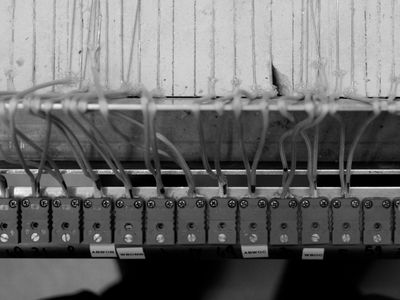
Pilotfish, a design studio, was involved in the design of a wearable device for a well-known electronics manufacturer. They approached me to review the mechanical design of a complicated optical assembly critical to the functionality of the device.
I conducted a detailed 3D tolerance stack-up analysis, which identified some issues. I helped the client and their suppliers to understand their precision requirements better, and to modify the design to ensure functionality.
I also produced 100+ pages of production drawings for the first small batch production of the device. The drawings were delivered on a very tight schedule to meet the client's milestones.
SynchroStor - industrial heat pump market study #
Year: 2024
Client: early stage startup
Work: market research, business development
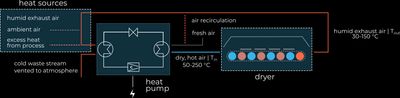
SynchroStor, a seed-stage startup, have developed a novel compressor technology for an energy storage application. The same technology could be used for decarbonising industrial heat. They approached me to help them evaluate the business opportunity in the heat sector.
I carried out detailed market research to position the company within the heat pump industry. Then, I conducted an extensive review of scientific and industry literature to identify niches for which their technology was best suited. I analysed the two most promising industry sectors in detail, and produced materials to help them approach potential clients in those sectors.
Camberwell Energy - German electricity market reform policy study #
year: 2024
client: business development services provider
work: policy analysis
Camberwell Energy, a UK-based business development services provider focused on the energy transition, wanted to understand changes to the German electricity market due to take place in 2024-2027. I provided a detailed analysis of the situation, based on public documents, notably a whitepaper released by the German government. I placed the reform in the broader scope of the EU electricity markets, and explained how it will impact a particular business opportunity that Camberwell Energy was exploring. I created written materials and graphics that concisely represented the topic.
Luft - electrified heat #
year: 2022-2024
project: Startup - decarbonising residential heating
At Luft, my cofounder and I worked on cleaning up residential heating, which is one of the lowest-hanging fruit of the energy transition, but it is not decarbonising as fast as it should be. We looked at a bunch of ways of doing it, from tiny residential heat pumps to city-sized large thermal energy storages.
I learned a lot about entrepreneurship, the built environment, and project finance.
Luft also got me interested in the energy system and technoeconomic analysis (TEA). You can see one of our TEAs here.
TEA - analysis of a large-scale renewable heating system #
year: 2023
client: internal
work: techno-economic analysis, literature research, expert interviews
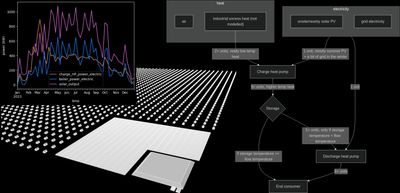
One of my core competencies is a detailed understanding of the decarbonisation of low-temperature heat. A big issue in this field, largely unaddressed today, is how we will provide carbon-neutral heat to cities in Central Europe, in the depth of winter, when solar PV output goes down to almost nothing. Many proposed solutions to this problem are not cost-competitive with gas heating, and therefore unlikely to be adopted by the market. I carried out a detailed study of a concept which integrated the cheapest source of thermal energy - solar PV run through a heat pump - with the cheapest form of energy storage - pit thermal energy storage. With storage so cheap (30cts/kWh), it is possible to store heat seasonally, from summer to winter, which enables using solar PV for heating.
I built a dynamic model of the system to prove performance under conservative assumptions, and a detailed financial model to assess project economics. I found that it could deliver levelised cost of heat on par with natural gas. I wrote a short whitepaper on the topic.
Agtech startup - computer vision system for precision agriculture #
Year: 2022
Client: early stage startup
Work: computer vision, IoT, software, mechanical design, electronics
The client, an early-stage tech startup, is developing a computer-vision based solution for monitoring of items in manufacturing. They required a special type of camera system for in-field monitoring. They couldn't source a solution on the market, so they turned to me to build it from scratch.
I built a small team composed of a mechanical, electronics, and software engineers. We tested multiple camera types on site, identified one which met the client's specification, and then proceeded to build an IoT system around it.
The camera needed to operate autonomously, without external power or data connections, in a difficult environment. We designed the power electronics, enclosure, and mounting. We wrote the firmware to process photos on device, and software to manage a fleet of cameras, integrated with the client's infrastructure. The system was solar powered, with its own mobile connection, rugged enough to withstand years of field use.
We produced the first prototype, along with documentation which allowed the client to make more as needed.
GaeaStar - pilot production system for branding sustainable single-use packaging #
Year: 2021
Client: early stage startup
Work: R&D, production jigs, production machinery
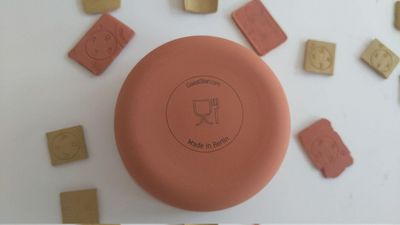
GaeaStar has developed a novel sustainable packaging solution. They were looking for a system to brand and customise items for their clients. In line with their commitment to 100% sustainability, their brief called for a machine which would brand hundreds of items per day without consuming any plastics. This meant that typical packaging branding methods, based on polymer inks, were out of the question.
I identified three possible solutions to this problem, and built prototypes to test them. I perfected the most promising process in collaboration with the client's designers to match the client's aesthetic. Finally, I built a machine and production jigs which implemented the process, and helped the client integrate it into their pilot production facility.
Consumer electronics startup - R&D for an automated electronics repair solution #
Year: 2021
Client: early stage startup
Work: R&D
The client, an early-stage startup, had an idea for a novel repair process for consumer electronics. I conducted a literature review and expert interviews to document state of the art repair techniques, and assess the feasibility of the client's approach. I also carried out first benchtop experiments. My work formed the basis of the client's subsequent R&D efforts.
Entrepreneurs First - venture builder #
year: 2021
Project: Company builder - hardware project management tools
I joined Entrepreneurs First, a venture builder, to learn about entrepreneurship. I've always been frustrated with software tools available to hardware engineers, so during my time at EF I worked on version control and file sharing for mechanical engineers.
Recurse Center - programming retreat #
year: 2021
project: Programming retreat
I'm a member of Recurse Center - a programming community focused on self-directed learning. . In 2021 I took three months off to attend an RC batch and improve my knowledge of computer science fundamentals.
RCs is the most wholesome engineering community I've encountered.
If you'd like to become a better programmer, I highly recommend that you also join the Recurse Center!
Undead - improved face mask concept #
Year: 2020
Client: early stage startup
Work: R&D, literature research, prototyping
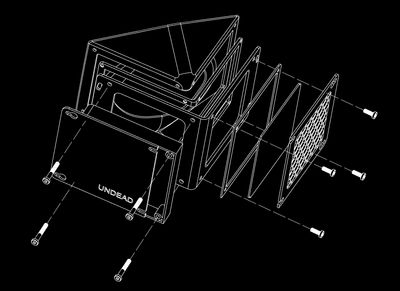
Undead was a startup formed during the 2020 Coronavirus pandemic to develop a better face mask. They had a list of things they wanted to improve on versus commercial designs. I carried out literature research to identify which were possible and which were not. Then I built a modular prototyping mask platform which allowed Undead to test different ideas as modules. I built a number of prototype units, which were used in fundraising and customer development. I also created renders and videos showcasing the platform.
Shield Force - manufacturing protective equipment during COVID #
year: 2020
project: PPE manufacturing organisation
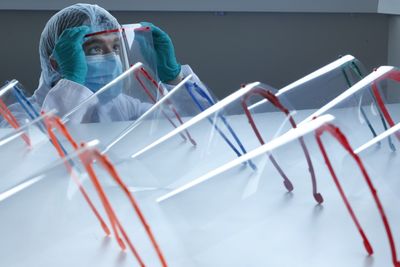
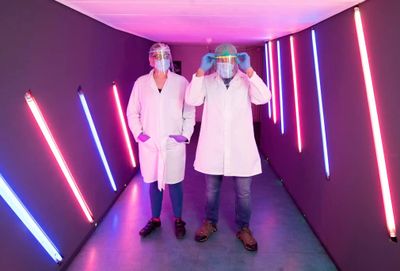
At the start of the COVID-19 pandemic, I got together with a few friends from the Edinburgh Hacklab to think how we could use our skills to help during the crisis. A friendly doctor said that she could not buy face shields - an indispensable piece of PPE for healthcare workers working with infectious patients.
We immediately produced 5 prototypes based on available open-source designs, and collected feedback from ICUs. We set up a manufacturing facility for the winning design, staffed by volunteers from the local community. We built an automated 3D printer farm and optimised it for speed. Within a week, we were producing 500 units per day. Within two - 1000. This still wasn't enough to keep up with the demand, so we quickly moved to injection moulding.
Our injection moulded design went through 13 iterations with clinicians (within two weeks). We optimised everything, from the optical properties of the transparent visor, to the stiffness of the headband. This close feedback loop paid off - doctors preferred our final design to the ones they used to buy from regular suppliers. Our shield passed CE testing to EN166 standard at the first go. We eventually delivered almost 50000 shields to hospitals all around the world, from the Scottish Borders to Bethlehem in Palestine.
This was my first attempt at building an organisation. In addition to managing projects and people, I was responsible for operations - setting up and scaling the factory, ordering parts and supplies, maintaining cash flow etc. We grew exponentially - from a handful of people to over 100 within a month, and so did our production capability. Fortunately, after 4 months, we were no longer needed, as conventional suppliers have caught up with demand.
This work was featured in the BBC, The Guardian, The Scotsman, and The Herald.
Master's - RL robotics control #
year: 2019
project: Soft robotics platform controlled by a deep reinforcement learning algorithm
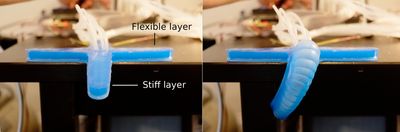
I saw a video of a Reinforcement Learning (RL) algorithm learning how to walk on a four-legged simulated robot, and I decided to build a real-life version of it for my Master's thesis. My advisor, dr Adam Stokes from the Soft Systems Group at the University of Edinburgh, was exploring control methods for soft robots at the time;he suggested that I use a soft robot as my test platform.
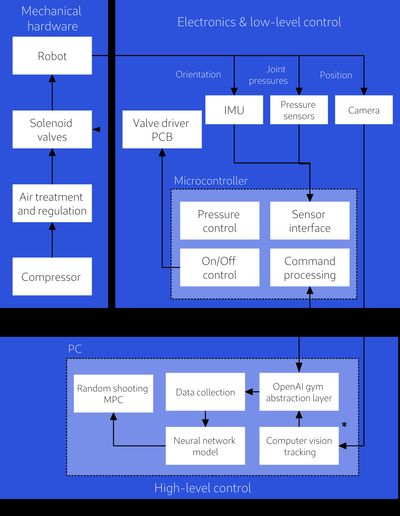
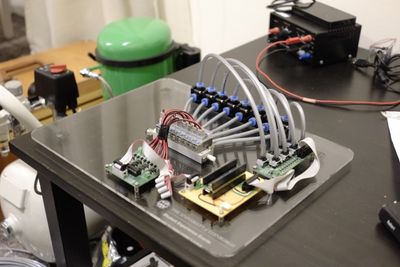
Soft robots are made from compliant materials, which makes them robust and safe when interacting with humans, but also difficult to control using conventional methods, and computationally expensive to simulate. In my thesis I applied RL to teach a robot to walk, in real time, on physical hardware. I built the entire technology stack for this project.
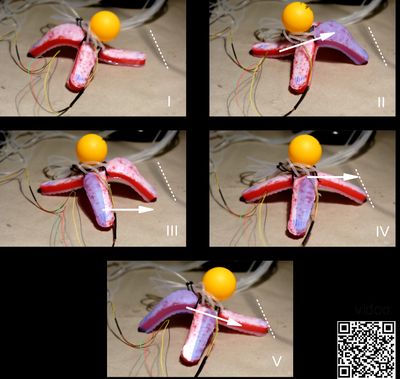
The robot learned how to move forward. It was of course much slower than hand-coded, open-loop control methods, but it developed two distinct, novel gaits. You can find more details in my thesis.
Artemis - industrial hydraulics #
year: 2018
project: Design, testing, control of hydraulic machinery
Artemis Intelligent Power was a spin-out from Edinburgh University. They invented a new type of hydraulic machine, much more efficient and controllable than state-of-the art. Artemis is where I learned how to do real engineering. I first joined them for an industrial internship, and then came back straight after university for my first job. First, I was part of their mechanical design team, where I designed, assembled, and tested 100kW+ machines. Work at Artemis was very hands on - they taught me how to run a lathe and a mill, how to build hydraulic circuits, how to instrument test rigs, how to work with technicians and suppliers etc. Then, I joined the Controls team, where I worked on the models and software that controlled the machines. I learned how to build dynamic models in Matlab/Simulink, how to build electronics and control systems, how to design things etc.
Artemis - DDPlayer #
During my time at Artemis, I realised that the valves on their machines switch so fast, that they could be used to play music. I hacked a pump controller, connected a MIDI keyboard to a Raspberry Pi, wrote some C to interface between the two, and got this:
UHTS - energy storage #
year: 2017
project: Control system for an energy storage rig
UHTS stands for Ultra-High Temperature Energy Storage - storing energy at grid scale, in a well-insulated lump of molten metal. I worked for a research group led by dr Adam Robinson, which was later spun-out as Exergy3. My job was to develop a control system for their first prototype.