Hiking the GR20
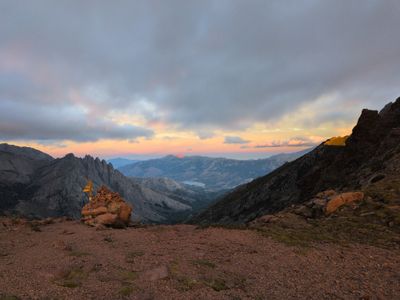
This October we went to Corsica to hike the extremely well documented GR20 - an ~180km thru-hike across the mountainous and unpopulated heart of the island. As usual, we won't say much here that can be found elsewhere - except to agree that it is truly spectacular.
This post is brought to you by my hiking buddy Hamish, who took the responsibility of writing up this trip report.
The route and navigation #
We split the stages as recommended here. On some days we walked a little further, or stopped earlier, but in general we found it to be a good guide. Where possible, we took the 'high route' alternatives described in the Cicerone guidebook, blazed with horizontal yellow stripes. These were some of our favourite days of the trip, and we highly recommend them. Blazes abound on the GR20; if you haven't seen one for three minutes, you've gone wrong and should backtrack. We didn't carry a paper map, and used the GPX track on our phones only once. We took the aforementioned guidebook, downloaded on an e-book reader. While it was nice to have an idea of how long and high the stages were, we did not rely on it much for way-finding. Indeed we found out when we got home that Stage 4 has been changed since our edition of the guidebook was published (2012), and we had totally failed to notice. This is mostly because a lot of the early stages have very similar descriptions - a long, steep, rocky ascent, followed by spectacular views and a ridge walk, descending to a charming hut in the evening. A lot of people describe the route as tough. We found it fine - there is a lot of scrambling, but nothing that felt sketchy. However, we can well imagine that for people off-balanced by their 20kg backpacks (we met a decent number of these), or in the rain, these sections could be tricky.
Accommodation - huts #
Wild camping is not permitted on the GR20, understandably, given how many people trek annually, and the erosion-prone soil. The huts offer camping spots, and are luxurious, with free cooking gas, warm showers and (not free) three course dinners. All of this is flown in by helicopter. Hiking in October meant the huts were only officially open the first four days of our hike. Booking in advance gives a 50% discount (at least for camping). After the huts were shut, most left open a winter room, but closed their toilets and showers. On the day the season officially ended, we witnessed the extremely efficient operation of a team of six Corsicans and one helicopter lifting out tons worth of gas cannisters, and lifting in vast piles of wood for the winter. The helicopter came and went six times in the time it took us to eat breakfast. It was quite a sight.
Off-season hiking in October #
We found early October to be a perfect time to hike. We saw around ten people each night, compared to hundreds in high season. Water is described as a problem in many people's trip reports. We had a water filter, and capacity to carry 5L between the two of us. We never ran out. The weather was mostly sunny but cool in the high mountains. On two days it was cloudy and rained a little. The only extreme weather we experienced was a night time thunderstorm, while we were camping at Refuge de Ciottulu di I Mori, an exposed hut just below 2000m. The campsite had several new rivers in the morning, running through camping spots - luckily not ours - and we met one person whose tent had ripped apart. We were grateful not to have been hiking during that time. Mostly it was perfectly calm, to the extent that we slept one night without a tent under the stars.
Nutrition #
We hiked fully vegan, as always. Before starting the GR20, we visited the post office in Calenzana and posted a package of our food for days 6-10 to la Halte du Prince, a campsite in Vivazzona that generously agreed to accept a parcel for us. Our menu is becoming standardized. This time we aimed for 3500 calories per person per day and took:
Breakfast: granola with powdered coconut milk Lunch: crackers with vegan kabanossi and schmalz - a German lard-like spread with onion and apple - sounds disgusting but is surprisingly good Dinner: jackfruit mince Bolognese with powdered mashed potato / fancy vegan ramen with soy strips / Thai curry with couscous / peanut butter noodles (all containing a lot of oil) Snacks: a mountain of nuts, chocolate, pringles and bars
We wish we had known... #
Super stony ground #
The ground in the Corsican mountains is extremely stony and dry. This wears hard on gear. We broke three stakes, and bent several more. After foraging some abandoned string from campsites, we started using a lot of rock anchors in places where it was impossible to get a stake in. Our tent footprint had so many holes by the end of the trip that we threw it out, well aware that its sacrifice had saved the tent itself. We carry a repair kit, and used more of it than we have on any other trip; partially on the footprint, partially on a friendly neighbour's air mat which had holes from drying it on a rock, and partially on the following tale.
Foxes #
On the third night, we woke up to find tent bag (with the tent inner inside, which we had not used that night) a few meters from the tent, full of claw holes and smelling of fox urine. This was very sad. We had, in fact, been warned about the foxes by a fellow hiker the day before, but hadn't noticed we left the bag just outside the tent in the dark of the previous evening. Luckily the tent inner, which was the only really important bit, had just a few holes and had escaped the urine. Beware of foxes!
Hitchhiking and Bastia #
We hitchhiked up to Bastia from the end point of the hike, Concha, as there are no buses on Sundays. It took a long time for someone to stop and we were very lucky our new friend was going all the way there. It doesn't seem like Corsicans are that into hitchhikers. We had done zero research on Bastia, and had a day there before travelling home, as we had left some buffer time for the hike which we hadn't needed. We were delighted to discover what a lovely town it is, with twisty alleys, colourful buildings, and the still-warm sea lapping the beaches.
Conclusions #
A lot of people don't have the best time on the GR20 - the reported dropout rate is between 50% and 85%, depending on who you ask. We probably got lucky with the weather, but it seems like many of the things that people complain about - getting up at 4AM to avoid scorching midday sun and queues at the more difficult passes, overcrowded huts, litter, lack of water - can be avoided by going just after the end of the season.
The GR20 is an interesting route. On the one hand, there are few places in Europe where you can walk for days without encountering substantial civilisation. On the other, it is very accessible - we set out on two weeks' notice, spent a day on preparations, and still felt very well equipped. This relative accessibility encourages many people to do it as their first long-distance hike, which we would not advise. But if you're a somewhat experienced hiker, you'll experience great nature with a very low prep day to hiking day ratio.